Certain choices can unlock your organization's hidden potential or completely eliminate it. Many times, the impact is not immediate, but it becomes noticeable in the numbers of each quarter and in the annual balance sheet.
What decisions are we talking about and why is their impact definitive in the growth or stagnation of today's organizations? We help you understand them one by one with a brief overview.
Decisions that hinder your organization's scalability
Using generic software
Providers sell it as the definitive solution to all your problems, but once you buy it and start working with it, you realize that this is not the case.
Generic software can solve basic needs, but it rarely truly adapts to your processes, rules, and objectives. Its main limitation is that it forces your business to adapt to the tool, rather than the other way around.
That can work when the operation is simple, but it starts to fail as demand grows and you need to scale your integrations, sales channels, and other resources.
Relying on standard tools often creates a false sense of efficiency. Initially, it speeds up the implementation process, but over time, its limitations become clear:
- Duplicated tasks.
- Incomplete reports.
- Workflows that cannot be adapted.
- Internal teams spending hours solving "patches".
Adopting a monolithic architecture
It can be useful in the early stages, but, as happens with generic software, it becomes an obstacle when the product starts to grow and needs to evolve in parts.
The problem is technical and organizational. Every change depends on too many interconnected components, which complicates testing, delays deployments, and increases the risk that an improvement in one area will affect another completely different one.
As the company grows, the monolith tends to slow down decision-making because any adjustment requires more coordination and more validation time. This limits team autonomy and makes it more difficult to respond to new business opportunities.
Using a single AI agent
If you are only looking to automate quickly, using a single artificial intelligence agent will be enough. However, if your medium- and long-term goal is to save time and increase productivity, it is not the solution you need.
In practice, using a single agent reduces specialization and responsiveness, because the agent will try to solve too many problems at once. This affects the accuracy, depth of analysis, and quality of the decisions it generates.
The future will require access to different types of data. According to Solace, 80% of AI agent use cases will require access to real-time, contextual, and ubiquitous information. This is impossible for a single agent in operations.
When the operation requires different types of reasoning, context, or validation, a solution dependent on a single agent falls short.
There is also a strategic risk: if all your operational intelligence depends on a single component, any failure or bias impacts the continuity of your business. You will build on a fragile structure that will prevent you from moving forward as you want.
Working with 100% manual processes
Every manual validation, record, follow-up, or update introduces delays and multiplies the possibility of errors. Over time, you will spend far more resources maintaining basic operations instead of fostering your growth.
The hidden cost of manual work is that it takes away your ability to scale. The more an organization depends on repetitive tasks performed by people, the less room it has to innovate, respond to customers, or make decisions with real-time data.
In a competitive environment, this represents slower execution and a structure that becomes progressively more expensive precisely when the business needs to become more efficient.
The financial return on automation is fast and significant. According to Kissflow, companies that invest in automation will reduce their operating costs by 22% within no more than 3 years.
What actions genuinely promote business transformation?
Investing in custom software
Custom software makes possible what a generic platform prevents you from doing: it adapts the tool to your business logic.
Instead of forcing you to fit your planning and processes into a rigid mold, the platform is built with your actual way of operating, selling, and scaling in mind.
This allows you to gain efficiency by eliminating unnecessary steps in your workflows. In addition, you can better integrate internal areas and respond precisely to needs that a generic product does not contemplate in its design.
The data confirms this. Nash Tech Global indicates that 70% of organizations would choose custom solutions over off-the-shelf software in scenarios where integration, control, and experience are critical aspects.
Developing a model based on microservices
From a strategic perspective, you discover that using a monolithic architecture means building on a heavy and impossible-to-divide foundation. If you need to maintain or update a specific component, it forces you to temporarily stop your operations.
Instead, a model based on microservices helps divide complexity into manageable parts. If you need to briefly isolate a module to make corrections, the rest of the system can operate without any inconvenience.
By separating functionalities, teams can work with greater autonomy, deploy improvements more quickly, and reduce the impact of errors. This turns the evolution of your product into a more orderly and less risky process.
Also consider that, as you incorporate new products, channels, or markets, you will be able to evolve by modules without rebuilding your entire technological foundation. This gives you key flexibility to respond to the environment without sacrificing speed or stability.
Implementing a multi-agent framework
Resilience, scalability, and less dependency. A multi-agent framework gives you the advantage of distributing tasks among different systems or specialized agents, rather than concentrating all intelligence in a single layer.
This is fundamental because each agent can focus on a specific function, whether it is:
- Analyze.
- Classify.
- Validate.
- Respond.
- Execute.
We are talking about a specialization that leads to better results and represents the step toward a deeper integration of artificial intelligence into your organization.
When each agent fulfills a clear role, the entire system grows in a more orderly way and adapts to different scenarios without losing control.
Creating automated workflows
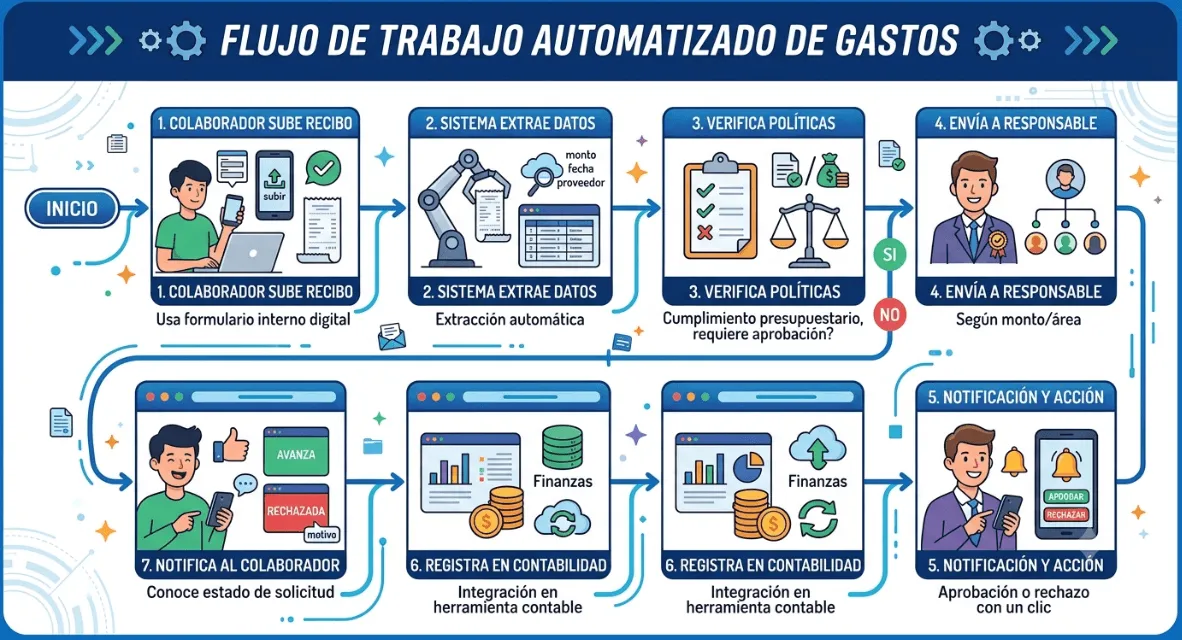
We have a completely automated expense approval and reimbursement sequence:
The example illustrates an important change: the greater speed of execution and precision you achieve when you automate certain processes.
It is a decision that reduces errors, eliminates repetitive tasks, and frees up time so you can focus on activities with greater strategic impact. Once your team stops investing energy in manual follow-up, there is more room for innovation.
ZoomInfo reports that 81% of sales representatives have shorter and more effective cycles thanks to automation. This is one of the different areas that benefit from implementing autonomous workflows.